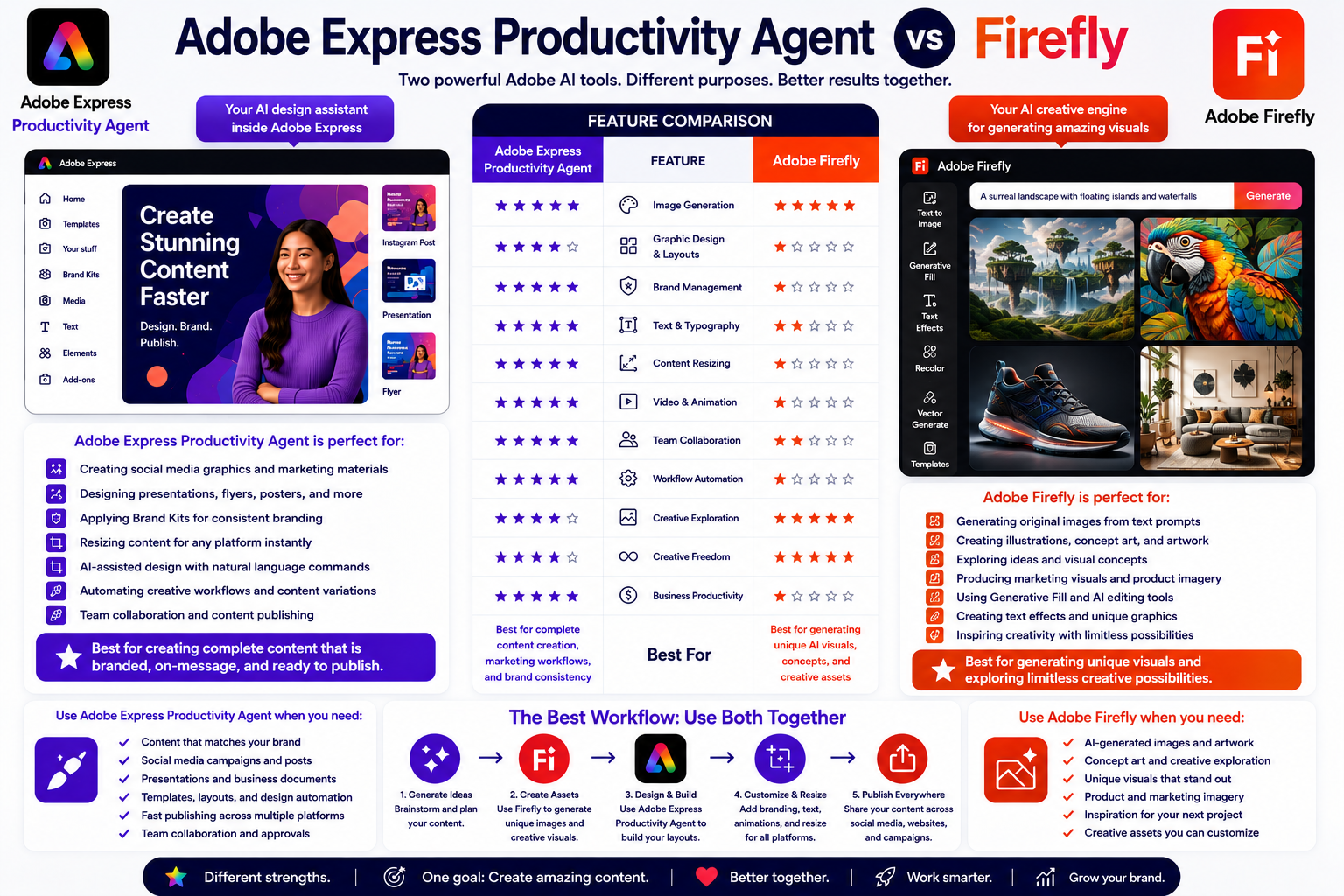
Adobe continues to expand Adobe Express beyond a simple design tool and into a complete AI-powered content creation platform. One of the most significant recent additions is the Productivity Agent, a feature designed to help users automate tasks, accelerate content creation, and simplify complex workflows.
If you’ve heard about the Productivity Agent but aren’t sure what’s new or why it matters, this guide covers everything you need to know.
What Is the Adobe Express Productivity Agent?
The Productivity Agent is Adobe’s AI-powered assistant built directly into Adobe Express.
Unlike traditional design tools that require users to manually create and edit every asset, the Productivity Agent helps users achieve goals by understanding instructions and performing multiple tasks automatically.
Instead of asking:
“How do I build this?”
You can increasingly ask:
“Can you create this for me?”
The Productivity Agent then assists with content generation, editing, organization, and workflow automation.
Why Adobe Introduced the Productivity Agent
Modern content creation involves much more than graphic design.
Teams often need to:
- Create content
- Resize assets
- Maintain branding
- Generate marketing copy
- Adapt content for multiple platforms
- Manage creative assets
Adobe’s goal is to reduce the manual work involved in these processes.
The Productivity Agent acts as an intelligent assistant that helps creators focus on ideas rather than repetitive production tasks.
New Capability #1: Natural Language Requests
One of the biggest improvements is the ability to work using simple instructions.
Instead of manually navigating multiple menus, users can describe what they want.
Examples include:
- “Create an Instagram campaign for my product launch.”
- “Turn this flyer into a LinkedIn post.”
- “Create multiple versions of this graphic.”
- “Generate a branded event promotion.”
The Productivity Agent interprets the request and begins assembling the necessary content.
This makes Adobe Express significantly more approachable for non-designers.
New Capability #2: Multi-Step Task Automation
Traditional design tools often require users to perform tasks one at a time.
The Productivity Agent can combine multiple actions into a single workflow.
For example:
A request might trigger:
- Image selection
- Layout generation
- Text creation
- Brand application
- Resizing
- Content variations
Instead of completing six separate tasks, users can accomplish much of the workflow through a single request.
New Capability #3: Content Generation
The Productivity Agent can help generate content directly inside Adobe Express.
Examples include:
- Social media captions
- Marketing headlines
- Product descriptions
- Promotional copy
- Event announcements
This reduces the need to switch between multiple AI tools.
New Capability #4: Brand-Aware Content Creation
For organizations using Brand Kits, the Productivity Agent can leverage existing brand assets.
This includes:
- Logos
- Fonts
- Colors
- Brand guidelines
As a result, generated content is more likely to align with company branding.
This is particularly valuable for:
- Marketing departments
- Agencies
- Small businesses
- Social media teams
New Capability #5: Intelligent Asset Repurposing
Content repurposing is one of the most useful additions.
The Productivity Agent can help transform existing assets into new formats.
For example:
A single webinar promotion can become:
- Instagram posts
- Facebook graphics
- LinkedIn visuals
- Pinterest Pins
- Email banners
- Presentation slides
Rather than rebuilding assets from scratch, users can adapt existing content much faster.
New Capability #6: Faster Multi-Platform Publishing
Every social platform uses different dimensions.
The Productivity Agent helps users prepare content for:
- TikTok
- YouTube
This dramatically reduces the time required to create platform-specific assets.
New Capability #7: Enhanced AI Workflows
Adobe has increasingly focused on workflow automation.
The Productivity Agent now helps users move through creative processes more efficiently.
Examples include:
- Generating drafts
- Suggesting layouts
- Applying branding
- Organizing assets
- Producing variations
The goal is to minimize repetitive work and speed up production.
New Capability #8: Improved Collaboration
Many Adobe Express users work as part of teams.
The Productivity Agent helps maintain consistency across:
- Marketing campaigns
- Social media content
- Sales materials
- Internal communications
By automating repetitive tasks, teams can focus more on strategy and review.
New Capability #9: AI-Powered Design Recommendations
Not every user is a designer.
The Productivity Agent can provide suggestions regarding:
- Layouts
- Visual hierarchy
- Content structure
- Color combinations
- Presentation styles
This helps beginners create more professional-looking content.
New Capability #10: Reduced Learning Curve
Perhaps the most important improvement is accessibility.
Traditional design software often requires extensive training.
The Productivity Agent allows users to work through conversation-like requests.
This makes Adobe Express more approachable for:
- Entrepreneurs
- Educators
- Students
- Freelancers
- Small business owners
The software becomes easier to use because users describe goals rather than manually executing every task.
What Hasn’t Changed?
Despite its new capabilities, the Productivity Agent is still a tool—not a replacement for human creativity.
Users should continue to:
- Review generated content
- Verify accuracy
- Check branding
- Make creative decisions
- Refine final designs
The best results typically come from combining AI assistance with human judgment.
Who Benefits Most from the Productivity Agent?
The feature is especially valuable for:
Content Creators
Generate more content in less time.
Small Businesses
Create professional marketing assets without a dedicated design team.
Marketing Teams
Maintain consistency across large campaigns.
Educators
Develop presentations and educational materials more quickly.
Agencies
Scale content production while reducing repetitive work.
How the Productivity Agent Changes Adobe Express
Before AI-powered workflows, Adobe Express primarily focused on manual content creation.
The Productivity Agent shifts the platform toward:
- Goal-based creation
- AI-assisted workflows
- Automation
- Content generation
- Intelligent adaptation
In many ways, Adobe Express is evolving from a design tool into a productivity platform for content creation.
What’s Next for the Productivity Agent?
Adobe has made it clear that AI and automation will continue to play a major role in the future of Adobe Express.
Future improvements may include:
- More advanced automation
- Better content planning
- Deeper brand intelligence
- Cross-channel campaign creation
- Expanded collaboration tools
- Enhanced personalization
As Adobe continues developing AI-powered experiences, the Productivity Agent is likely to become increasingly capable.
Final Thoughts
The Adobe Express Productivity Agent is one of the most significant additions to Adobe Express in recent years. It introduces natural language interaction, workflow automation, content generation, brand-aware design assistance, and intelligent asset repurposing—all aimed at helping users create more content in less time.
For beginners, it simplifies the design process. For businesses and content teams, it offers a way to scale creative output without dramatically increasing workload. As Adobe continues investing in AI, the Productivity Agent is poised to become a central part of the Adobe Express experience.