Adobe Express allows users to create multi-page projects for presentations, PDFs, brochures, reports, flash cards, worksheets, social media carousels, portfolios, and other content that requires more than a single canvas. Adding pages is one of the most useful features when building larger projects because it helps organize information and create a logical flow from one section to the next.
Whether you’re creating a business presentation, a marketing brochure, or an educational resource, Adobe Express makes it easy to add, duplicate, rearrange, and manage pages.
In this guide, you’ll learn how to add pages in Adobe Express and organize multi-page designs effectively.

Quick Answer
To add a page in Adobe Express:
- Open your project.
- Locate the Pages panel or page navigation area.
- Click Add Page or the + button.
- A new blank page will be created.
- Customize the new page as needed.
You can add as many pages as your project requires.
Why Add Pages?
Multiple pages help organize larger projects.
Common examples include:
Presentations
Create individual slides.
Brochures
Separate information into sections.
Reports
Organize content logically.
Flash Cards
Use one page per card.
Educational Materials
Create lessons and worksheets.
Social Media Carousels
Build swipeable content for platforms like Instagram and LinkedIn.
Step 1: Open Your Adobe Express Project
Sign in to Adobe Express and open an existing project or create a new one.
Projects that commonly use multiple pages include:
- Presentations
- PDFs
- Documents
- Web content
- Educational resources
Step 2: Locate the Page Controls
Adobe Express displays page controls differently depending on the project type.
Look for:
- Page thumbnails
- Slide navigation
- Page panel
- Plus (+) button
These controls are typically visible near the project workspace.
Step 3: Click Add Page
Select:
Add Page
or click the:
+
icon.
Adobe Express immediately creates a new page.
The page usually appears after the currently selected page.
Step 4: Customize the New Page
Once created, you can add:
Text
Headings, paragraphs, and captions.
Images
Photos, illustrations, and graphics.
Videos
Video clips and animations.
Icons
Visual elements and symbols.
Shapes
Design accents and layout structures.
Each page can have its own unique design.
How to Duplicate a Page
Sometimes it’s easier to copy an existing page.
Step 1
Select the page thumbnail.
Step 2
Choose:
Duplicate Page
Step 3
Edit the duplicated version.
This is useful when creating:
- Consistent layouts
- Templates
- Flash card sets
- Social media carousels
How to Rearrange Pages
You can change page order at any time.
Step 1
Select a page thumbnail.
Step 2
Drag it to a new location.
Step 3
Release it in the desired position.
This helps improve project flow.
How to Delete a Page
If a page is no longer needed:
Step 1
Select the page.
Step 2
Choose:
Delete Page
Step 3
Confirm the deletion.
Be careful, as deleted content may not always be recoverable.
Creating Multi-Page PDFs
Adobe Express is commonly used to create PDFs.
Examples include:
Brochures
Multiple informational sections.
Reports
Executive summaries and detailed content.
Study Guides
Organized learning materials.
Portfolios
Showcase multiple projects.
Each page becomes part of the final PDF export.
Creating Presentation Slides
Each page can function as a presentation slide.
Typical structure:
Page 1
Title slide
Page 2
Introduction
Page 3
Main content
Page 4
Supporting details
Page 5
Conclusion
Adobe Express makes slide creation simple.
Creating Social Media Carousels
Many creators use Adobe Express to build carousel posts.
Examples:
Instagram Carousel
One message per page.
LinkedIn Carousel
Educational content across multiple slides.
Pinterest Story Content
Sequential information sharing.
Each page becomes a separate image in the carousel.
Creating Flash Cards
Digital flash cards work especially well with multiple pages.
Page 1
Question
Page 2
Answer
Page 3
Question
Page 4
Answer
This structure is easy to duplicate and expand.
Best Practices for Multi-Page Projects
Maintain Consistent Design
Use the same:
- Fonts
- Colors
- Layout styles
throughout the project.
Use Clear Section Breaks
Separate major topics logically.
Number Pages When Appropriate
Useful for reports and presentations.
Review Flow
Ensure pages follow a logical sequence.
Keep Layouts Consistent
Consistency improves professionalism.
Common Mistakes
Too Much Content Per Page
Break information into smaller sections.
Inconsistent Design
Use a unified visual style.
Disorganized Page Order
Review page sequencing before exporting.
Duplicate Content
Check for accidental repetition.
Missing Titles
Clearly label sections and pages.
How Pages Work in Different Adobe Express Projects
Presentations
Pages become slides.
PDFs
Pages become PDF pages.
Flash Cards
Pages become individual cards.
Carousels
Pages become separate social media images.
Web Content
Pages may become sections depending on the project format.
Exporting Multi-Page Projects
After adding pages:
- Click Download.
- Select a format.
Common options include:
Best for documents and reports.
PNG
Best for individual pages and social media.
JPG
Best for sharing online.
Adobe Express exports all pages together when supported by the selected format.
Adobe Express vs Traditional Publishing Tools
Adobe Express provides:
- Simple page management
- Easy drag-and-drop editing
- Fast content creation
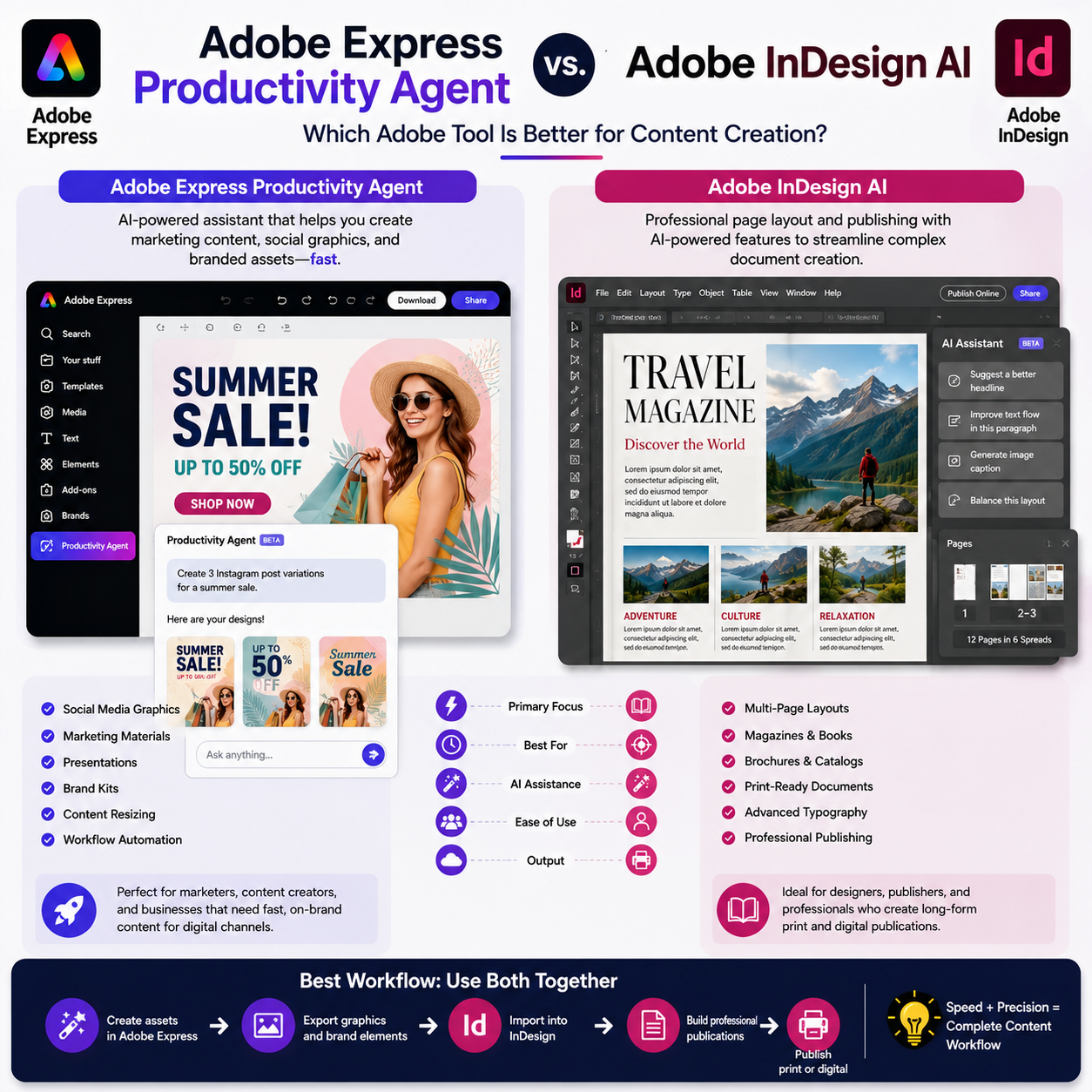
For more advanced publishing workflows, Adobe offers:
Adobe InDesign
Designed for:
- Books
- Magazines
- Catalogs
- Professional print layouts
However, Adobe Express is often sufficient for everyday projects.
Frequently Asked Questions
Can I add multiple pages in Adobe Express?
Yes. Adobe Express supports multi-page projects.
How do I add a new page?
Click the Add Page button or the plus (+) icon within the page controls.
Can I duplicate pages?
Yes. Existing pages can be duplicated and edited.
Can I rearrange page order?
Yes. Pages can be dragged into a new position.
Can I export all pages together?
Yes. Multi-page exports are supported in formats such as PDF.
Final Answer
To add a page in Adobe Express, open your project, locate the page controls, and click the Add Page or + button. Adobe Express will create a new blank page that you can customize with text, images, graphics, and other content. Multi-page projects are ideal for presentations, PDFs, brochures, reports, flash cards, educational materials, and social media carousels, making Adobe Express a flexible tool for creating organized, professional content.